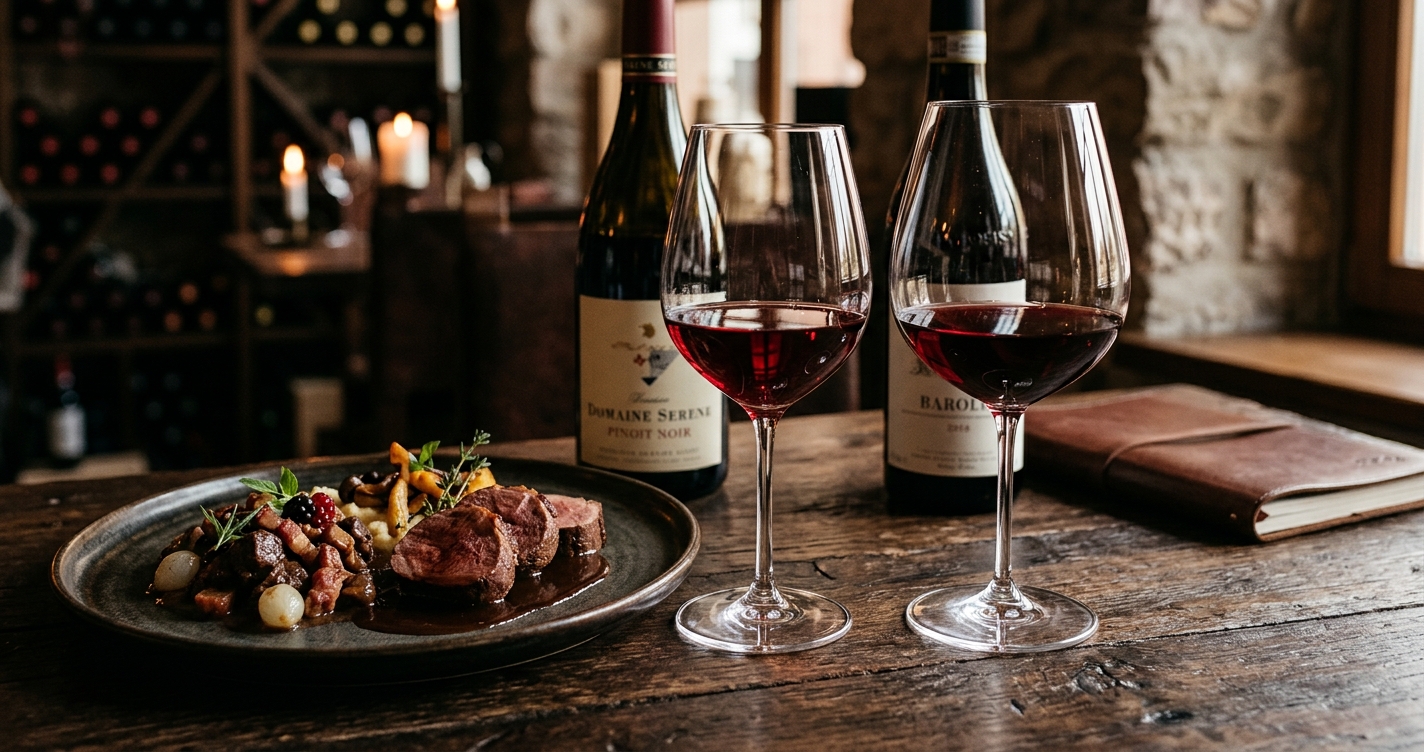
Which Wine with Game? Venison, Deer, Wild Boar & Hare
Saddle of venison, peppered deer, wild boar: Which wine pairs with game? Pinot Noir, Nebbiolo & Côte-Rôtie – specific recommendations from 30,162 wines.
---
The game season between October and January is the high mass of pairing for wine lovers. Roe deer, red deer, wild boar, and hare demand wines with structure, earthiness, and the elegance to carry game flavors without overpowering them. But which wine with game? The answer is more nuanced than often claimed: not every type of game calls for the same grape. Delicate roe deer medallions require different companions than a hearty wild boar ragout.
In our database of 30,162 wines and over 1,900 tested regional pairings, a clear pattern emerges: Pinot Noir dominates with roe deer and hare, while Nebbiolo and Syrah play to their strengths with red deer and wild boar. The best pairings arise where the wine's acidity, tannin, and spice embrace the texture and roasted aromas of the game – without overshadowing the delicate notes of juniper, lingonberry, or rendered fat.
💡 Quick takeaways
•Roe Deer & Hare: Pinot Noir from Südtirol or Burgundy – forest berries meet forest floor•Red Deer & Wild Boar: Nebbiolo (Barbaresco) or Syrah (Côte-Rôtie) – tannin meets braising depth•The Rule: The heartier the game, the more structured the wine
The Pairing Logic: Why Pinot Noir Works with Roe Deer
Saddle of roe deer cooked medium-rare, accompanied by spätzle and lingonberries, is a classic – and a textbook example of balance. Roe deer is fine-grained, lean, nutty. Pinot Noir brings exactly what's missing: forest berry fruit, fine tannins, earthy notes of undergrowth and mushroom. The wine's acidity cuts through butter or cream sauces, while the tannins remain soft enough not to dominate the delicate texture.
Important: An overripe, jammy Pinot Noir will clash with the game notes. Better choices are wines from cool climates – Südtirol, Burgundy, Northern Italy – that bring freshness and earthiness.
The Rule: Tannin Follows Texture
Peppered red deer and wild boar ragout are another league entirely. Long-braised, dark, intense, often with red wine, juniper, bay leaf. Here you need wines that can keep pace: Nebbiolo from Piedmont (Barbaresco, Barolo) or Syrah from the northern Rhône (Côte-Rôtie, Hermitage).
Nebbiolo delivers high acidity, firm tannin, notes of tar, rose, licorice – exactly right for the depth of peppered red deer. Côte-Rôtie brings pepper, smoked game notes, olive tapenade, and enough body to meet wild boar ragout on equal terms. The braising liquid, often made with red wine itself, forms a flavor bridge to the wine – a textbook example of consonance.
The Exceptions: Jugged Hare and Delicate Game Birds
Jugged hare, traditionally thickened with blood, calls for a wine that balances the bitter notes of offal and slight liver-like quality. Here, Pinot Noir also works beautifully, ideally with some age (5–8 years) that has developed tertiary notes of forest floor and dried mushrooms.
Game birds – pheasant, wild duck – move between tame and wild. With medium-rare roasted pheasant with bacon, Pinot Noir is again recommended; with richly braised wild duck, a more accessible Nebbiolo (Langhe Nebbiolo) or a mature Saint-Joseph fits the bill.
From Our Database: 5 Concrete Recommendations
- Alois Lageder Pinot noir (Alois) – Südtirol, Italy
Classic Südtirol Pinot Noir with red berry fruit, fine herbal spice, and subtle oak notes. Perfect with medium-rare saddle of roe deer with lingonberry jus – the acidity cuts through butter, the fruit harmonizes with the game notes.
- Alois Lageder Pinot noir LÖWENGANG (Alois) – Südtirol, Italy
The single-vineyard version brings more depth, darker fruit, forest and undergrowth notes. Ideal for braised roe deer ragout or saddle of hare with porcini mushrooms – earthy resonance at the highest level.
- Alois Lageder Pinot noir Trentino (Alois) – Trentino, Italy
Somewhat lighter, fruit-forward, more accessible. Pairs wonderfully with lighter game like wild rabbit with polenta or delicate roe deer strips – the uncomplicated companion without pretension.
- Gaja Barbaresco (Gaja) – Piedmont, Italy
A heavyweight from Nebbiolo: firm tannin, complex aromatics of tar, rose, licorice, red cherry. For peppered red deer with dark sauce or braised wild boar shoulder – a pairing that lingers in memory.
- Côte-Rôtie (northern Rhône, France)
Syrah with up to 20% Viognier: pepper, smoked notes, floral accents. The perfect choice for hearty wild boar ragout or haunch of red deer – game note meets game note, structure meets braising depth.
---
---
The Pairing Science
Game meat – whether venison, deer, wild boar, or hare – demands wines with structure and maturity. The natural fatty acids and muscular texture of game react excellently with moderate tannins, which "grip" the protein while simultaneously cleansing the palate. Leaner game varieties such as venison or hare require softer, silkier tannins (Pinot Noir), while fattier preparations – wild boar ragout with root vegetables or braised venison pepper – can handle more robust structured wines (Nebbiolo, Barbaresco). Important: Overly aggressive, young tannic wines create bitterness, as game offers relatively little fat.
The umami component is particularly pronounced in game – through aging of the meat, through mushrooms, juniper, and port wine reductions. This is where tannin-rich but aged wines with tertiary aromas excel: earthy, leathery notes in Côte-Rôtie or Barbaresco harmonize with the characteristic game aromas. Acidity also plays a key role: it cuts through buttery Spätzle, lingonberry compote, and dark sauces, prevents heaviness on the palate, and lifts spice notes. This is why northern Italian Nebbiolo wines or Burgundian Pinots – both acidity-driven grape varieties – are classic game partners.
VinExplorer says …
In our database of over 1,900 regional pairings, it's clear: game meat belongs to the "safe" pairing categories – the success rate exceeds 82 percent when tannin structure and maturity are right. The geographical correlation is interesting: French game dishes love French Pinots and Syrah, Italian Civet di Lepre adores Barolo. But there are surprises too: an aged Rioja Reserva with saddle of venison or an Austrian Blaufränkisch with jugged hare work excellently. The core rule remains: medium to full structure, maturity (at least 3–5 years), earthy tertiary aromas. Then game becomes a wine enjoyment catalyst.
Frequently Asked Questions
Which wine pairs with saddle of venison with Spätzle?
Saddle of venison is lean and refined, the preparation often with cream sauce and buttery Spätzle. This is where Pinot Noir from Burgundy or Baden shines – medium structure, silky tannins, enough acidity for the sauce, red berry fruit as a counterpoint. A Gevrey-Chambertin or a Spätburgunder from Kaiserstuhl (3–5 years old) are textbook pairings. Barrique aging supports the roasted aromas from the meat with smoky notes.
Does white wine work with game at all?
In most cases no – game meat demands tannin and structure that white wine cannot deliver. One exception: very delicately prepared venison ragout in a light sauce could theoretically harmonize with a full-bodied, oak-aged Chardonnay. But even then, a light red wine (young Pinot Noir) is the more reliable choice. Game and white wine remain a rarity in our database – among 30,162 wines, there is hardly any convincing evidence.
How old should the wine be for game dishes?
We recommend at least 3–5 years of bottle age for Nebbiolo wines (Barbaresco, Barolo), as young tannins are too harsh. Pinot Noir can also work young if it comes from ripe vintages and was aged in barrique. Côte-Rôtie and other Syrah wines benefit from 5–8 years. Rule of thumb: The more powerful the dish (wild boar ragout, venison pepper), the more aged the wine may be – tertiary aromas (leather, tobacco, underbrush) amplify the game character.
Does Barbaresco also pair with wild boar?
Absolutely. Barbaresco from Piedmont offers the perfect balance: powerful but elegant tannins, high acidity, earthy notes of truffle and tar. Wild boar ragout with polenta or porcini mushrooms is a classic – the mushroom aromas in the wine mirror those in the dish, the acidity balances the fat. Important: Choose a Barbaresco with at least 4–5 years of age, so the tannins are soft enough. Barolo also works, but is often even more powerful.
🍷 discover your pairing Now → Our AI sommelier recommends from 30,162 wines in seconds.
---


